Event sponsorship is bought for the audience: real people gathered in one place, with emotions that transfer to the brand. In simple terms, a sponsor pays to take part in an event and gets advertising in return: a title sponsor gives the event its name, a general sponsor gets the main place in the package. The problem is that a typical sponsorship package sells surface, not audience: a logo on the poster, a banner by the stage, a mention from the stage. Here is how a brand should read sponsorship offers and what to demand so that the event delivers numbers, not just a photo report.
Below, in order: how a company becomes a sponsor, what a sponsor gets in return, how to draw up the agreement and how a brand should read sponsorship offers so that the event delivers numbers, not just a photo report.
What a sponsor is
A sponsor gives an event money, goods or services and gets advertising in return. Russian advertising law defines sponsor advertising as advertising that must mention the sponsor, so a sponsor is essentially buying advertising. This is what separates sponsorship from charity: a donor helps without advertising in return, a sponsor buys the audience’s attention.
Types of sponsorship
- By status. A title sponsor gives the event its name. A general sponsor gets the main place in the package. Official partners and category sponsors share the rest: bank, drinks, cars, telecom
- By contribution. Money, goods or services (water, transport, prizes), media support
- By object. A one-off event, a festival or tour, a sports team, a league, a broadcast
How to become an event sponsor
- Choose the audience, not the event. First decide whom you need to reach: families, fans, young people, business owners. Then look for events where these people gather
- Contact the organizer. Partnership contacts are usually on the event or club website. Ask for the sponsorship offer and data from past years: attendance, audience profile, what the report contained
- Shape the package around your goal. A standard package can almost always be changed: drop surplus carriers and add positions that produce audience actions
- Agree on the report in advance. Which numbers the organizer will hand over after the event and when
- Sign the agreement and deliver materials: logos, videos, host scripts, the post-show promo
What to include in a sponsorship agreement
- Amount and form of the contribution, payment dates
- Sponsor status and category exclusivity
- A list of advertising positions with quantities: how many mentions, which carriers, which minutes of the programme
- Form and deadline of the report with photos, video and numbers
- What happens if the event is postponed or cancelled
Legal details are best checked with your own lawyer, especially ad labelling and tax accounting.
What a sponsor gets in return
Sponsorship gives a brand its name in or next to the event title, space on carriers and in the programme, tickets and a hospitality area for partners, content for social media. The cost depends on audience size and status: from tens of thousands of rubles for a local festival to hundreds of millions for a league title. The easiest way to compare packages is the cost of reaching one viewer.
The key question is how much of this is measurable. More on that below.
What a typical package contains and what is measurable
- Logo on carriers: cannot be measured, reach is an estimate
- Brand zone: traffic counted manually, conversion depends on the staff
- Stage and social media mentions: reach visible only in the online part
- Brand prize draw: the first mechanic with collectable contacts, but usually a small share of the hall takes part
- The event’s digital placements: measurable, but that is ordinary internet advertising, the event itself plays no role
The result of most packages: the brand pays hundreds of thousands and receives photos of the banner and the number of tickets sold. Such an investment cannot be compared with performance channels, which is why sponsorship budgets are the first to be cut. Sports sponsorship works the same way: title sponsors in the RPL and KHL get the name, the kit and the boards, but no fan actions in the report.
What to demand from the organizer in 2026
The minimal set of questions for a sponsorship offer: what share of the event audience will perform a measurable action with the brand; what the report will look like; whether the brand keeps contacts with communication consents. If there are no answers, you are buying presence, not activation. The other side’s view, through the eyes of the organizer building the package, is covered in the article how to attract sponsors.
What a measurable package position looks like
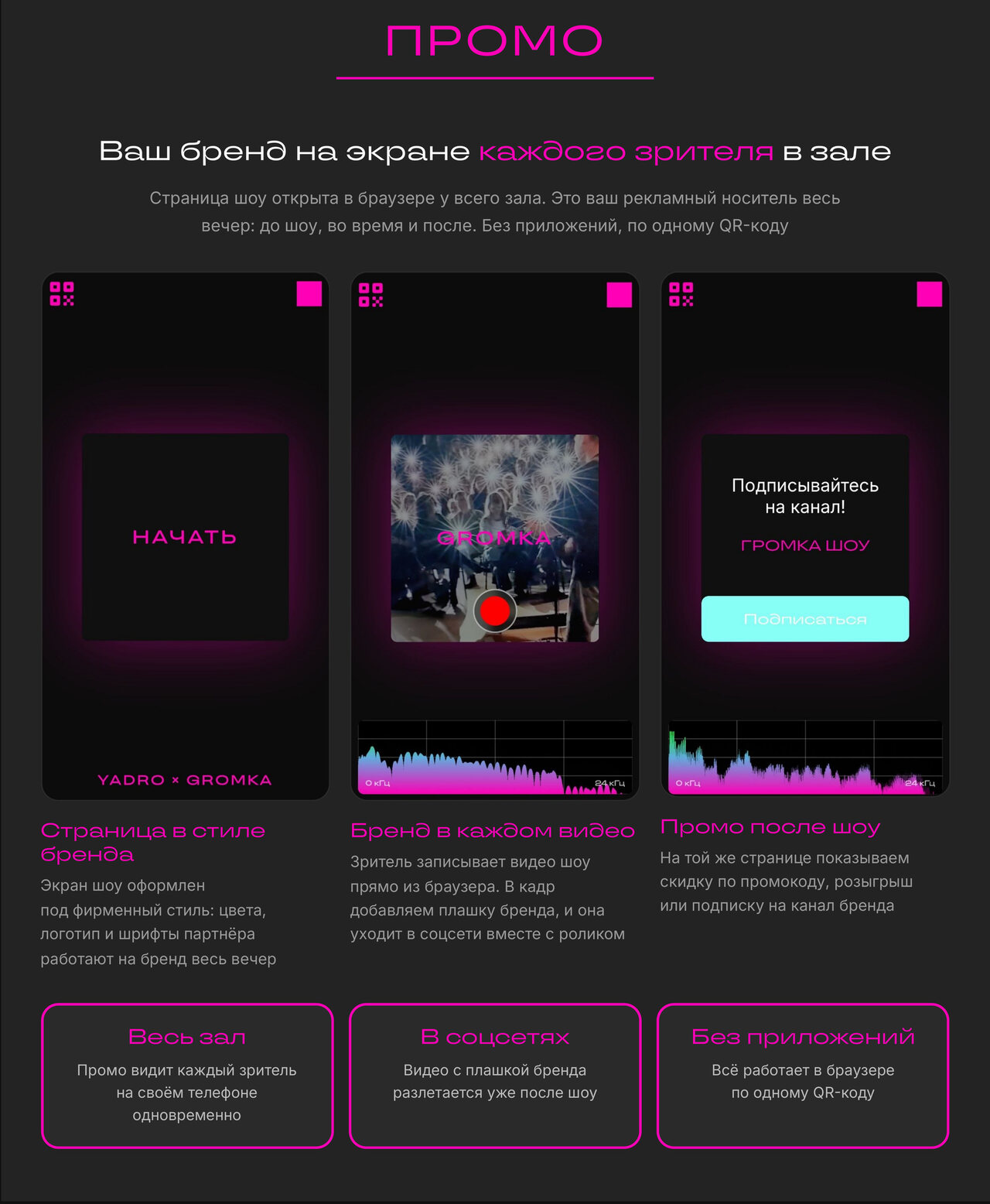
Our mechanic slots into the event as a separate package line. First the show: viewers scan a QR code, raise their phones, and the whole hall glows in sync with the music. People scan the QR for the show, not for an ad: at Krylia Sovetov vs Lokomotiv 16.6% of the stadium joined the show. Right after, a sponsor promo opens in every participant’s browser: a coupon, a free bet, a landing page, and a prize draw with a chatbot collects contacts with consents.
Funnel numbers: 25–30% of show participants click through to the promo in tests, every step is visible via UTM in analytics. How contacts are collected and what goes into the brand’s report is covered in the event lead generation article. An example of audience analysis for a sports sponsor is in the 2026 World Cup betting infographic.
A checklist for evaluating a sponsorship offer
- The package has at least one position with a measurable audience action
- The report contains a funnel: reach, actions, clicks, contacts
- Contacts are collected with consent and handed to the brand
- The position price can be converted into cost per action and compared with digital channels
- The mechanic requires no logistics from the brand: no promo staff, stands or equipment
If you are choosing events to sponsor or want to add a measurable activation to a package you already bought, package and report examples are in the For brands section. If you are an organizer looking for a sponsor, how to find one and win them with numbers is in how to attract sponsors.